Beyond “Authenticity” and Gatekeeping: What Happens When Khmer Cuisine Finally Gets to Be Seen
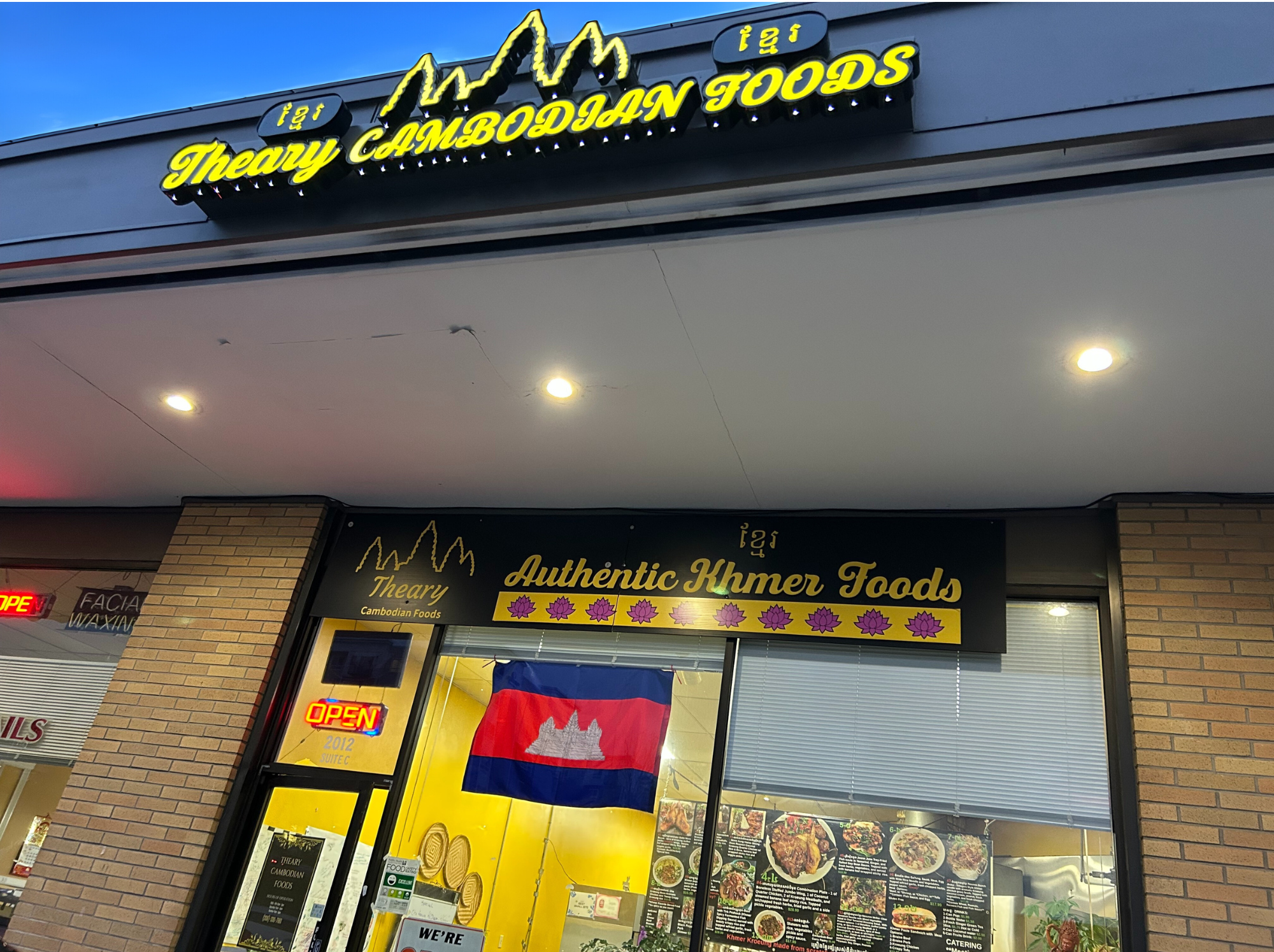
Theary Cambodian Foods
Located across the Town Square Park of Federal Way, WA, Theary Cambodian Foods is a small, unassuming restaurant. The moment you step inside, however, you will be greeted by the rich, prominent aroma of kreung—a Khmer spice paste—and a warmth reminiscent of a family kitchen.
As the owner and sometimes the only worker, Chef Theary can often be found juggling three to four dishes composed of many ingredients and different cooking methods. It must have been fate that I walked into the restaurant just after a wave of busyness. With a brief “sok sabay?” and sompeah, we made some small talk at the counter while she took my order. Small talk inevitably led to questions Khmer Americans commonly asked upon meeting one another. "Do you speak Khmer?" "Were you born here?" "Have you been to the motherland?" Between Khmer Americans, these questions come from a place of solidarity, regardless of one's answers.
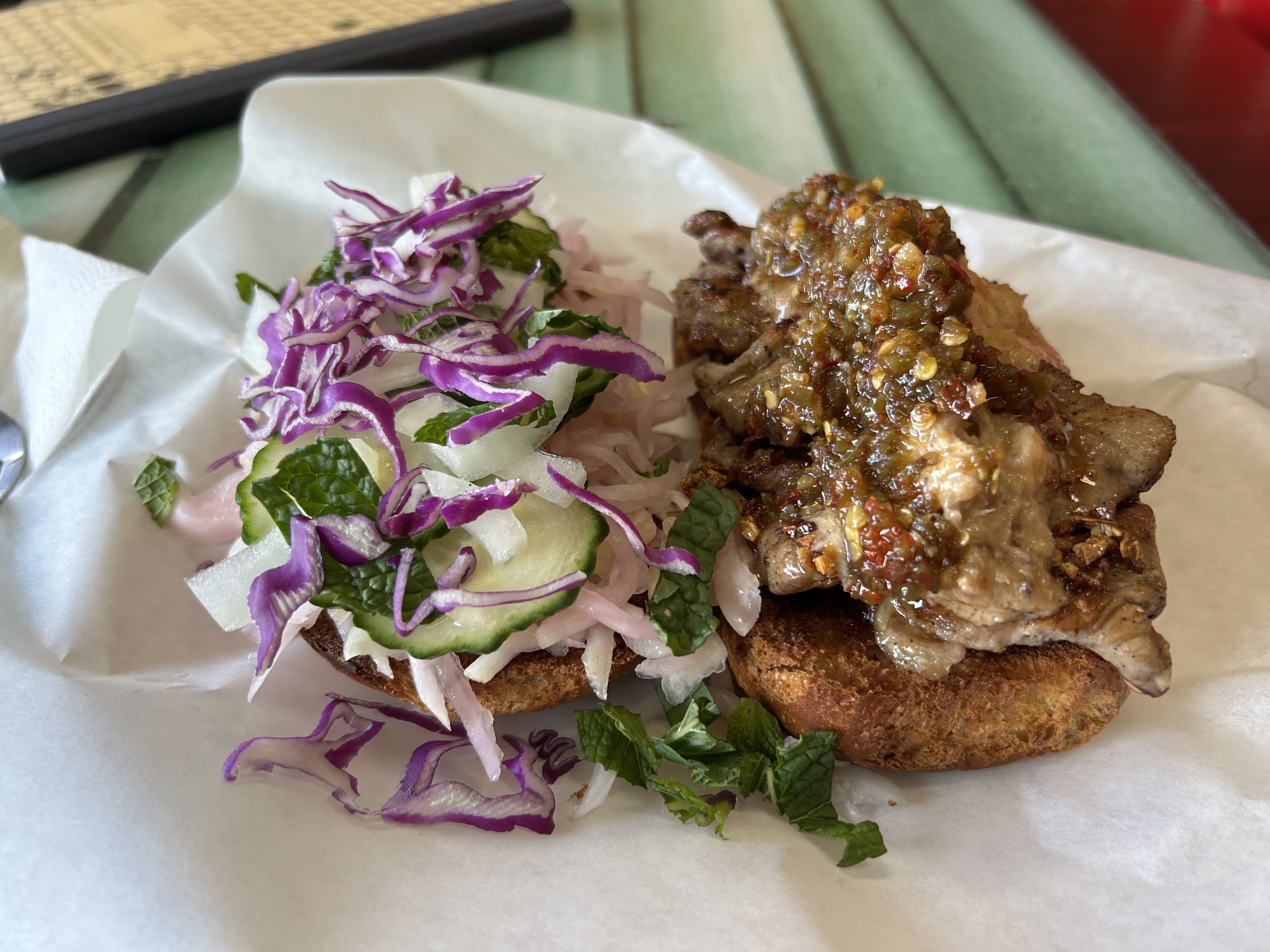
Num bang, served as two halves.
Halfway through our conversation, Chef Theary brought over my order of num bang. Two bites into the sandwich and I am immediately in awe. Not only were multiple familiar flavors firing on all cylinders, but they were combined in a way that I had never experienced before. Chef Theary served me something that evoked feelings of past, present, and future.
Khmer flavors are layered and avoidant of simple descriptions. The combinations of herbs, fermented pastes, and fresh ingredients creates tastes that shift on the palate. To attempt to conjure the gustatory experience of Khmer food without actually eating or cooking any is like trying to see out of your elbow.
On and off, Chef Theary and I exchanged bits and pieces of our backgrounds. Where we're from, what our parent's immigration to the U.S. looked like, and whether they experienced a genocide orchestrated by a pseudo-communist faction that facilitated auto-genocide. You know, the usual!
Between a few sentences, I devoured the num bang in less time than it took for me to order it.
Before I realized the plate was empty, my mind was already elsewhere—on the family history Theary had shared and the bits I had offered in return. Khmer people, including me, are so used to talking about "the war" that we're almost desensitized to it. I also reflected on how rare it has been for me to be able to turn my visits to Khmer restaurants into meetups with friends or family. I didn't realize at the time that one of these thoughts followed the other for a reason.
During my second visit, Chef Theary happily continued to chat with me about Khmer food and culture while she made my soon-to-be regular order of num bang. I asked why she opened up Theary Cambodian Foods. Chef Theary described her vision for Khmer cuisine and how she wanted it to gain the recognition and popularity it deserves. Her declarations grew in volume while she furiously zipped through the kitchen.
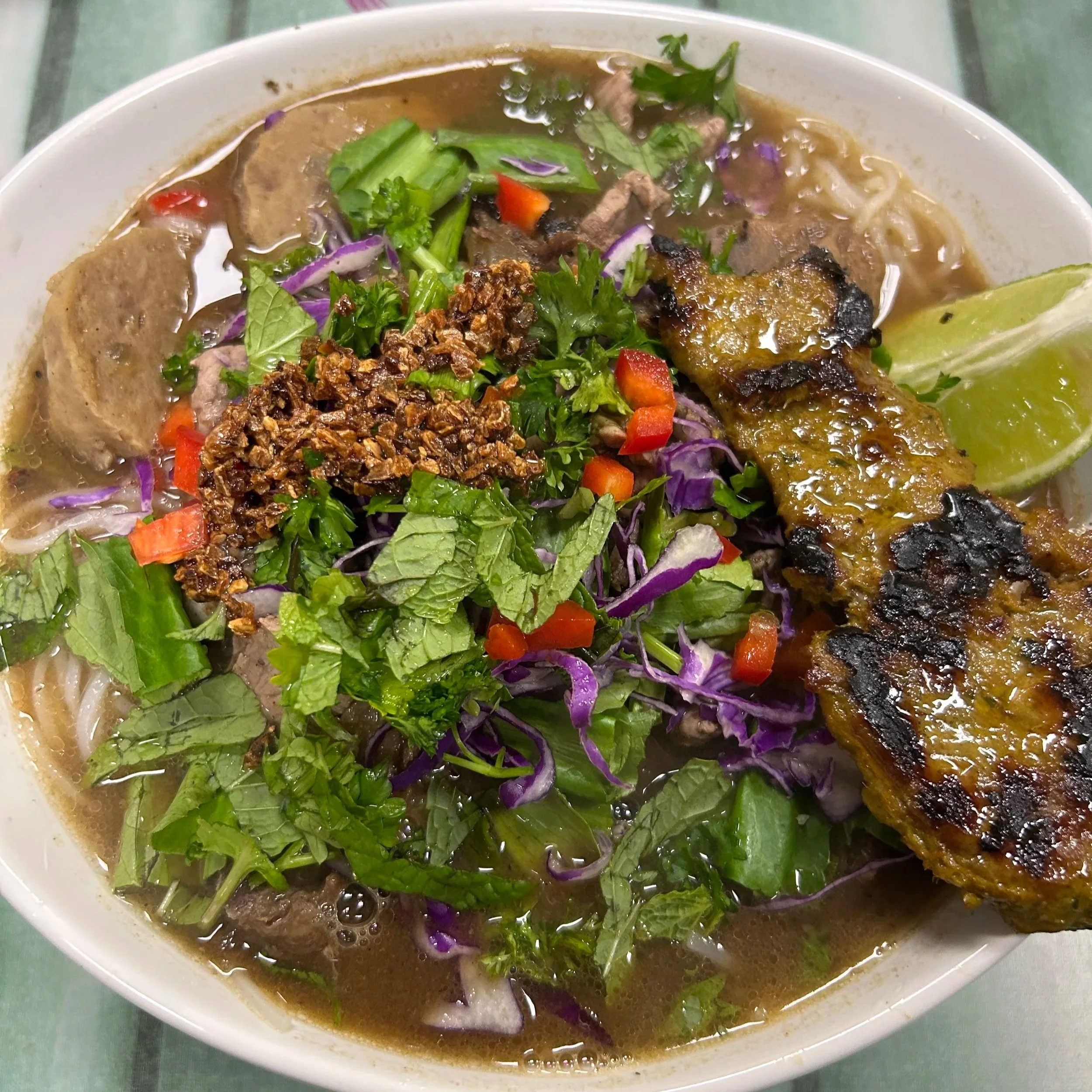
Kathiew, a Khmer noodle dish, with a meat skewer
Chef Theary and I hold similar complex feelings about the state of Khmer cuisine in the United States (particularly Western Washington). Cuisines are a representation of how cultures develop and evolve based on the people, technology, and agriculture surrounding it. But when we look at how Khmer cuisine shows up in the U.S., the connection between cultural breadth and socioeconomic recognition feels incredibly uneven. Nearly every conversation about Khmer cuisine in my life has only occurred among other Khmer Americans.
Even the true foodies I know, who chase substance instead of trends, only know so much about my people's cuisine or go out of their way to fill their stomachs on it. Visiting Khmer restaurants is always a plan but never the priority. I hate to admit it, but it took myself almost half a year after moving into the neighborhood before my first visit to Theary’s.
Surrounded by a heterogeneity of Asian foods in the greater Seattle area, I still find myself asking:
Why is Khmer cuisine so rarely part of this landscape?
What makes it uniquely difficult for Khmer restaurants to take root here?
And when will our flavors finally be recognized for the depth and history that come with them?
HALF A CENTURY OF KHMER AMERICAN RESILIENCY
The origins of food are always a contentious subject, and I will not pretend to be an expert. To keep it brief, Khmer cuisine is one of the oldest in Southeast Asia and has influenced the neighboring countries of Thailand, Laos, and Vietnam. Signature dishes such as amok trey, kuy teav, and num banh chok are often claimed or simplified elsewhere, but through colonization, war, and the Khmer Rouge era, Khmer food remains a vital and resilient part of Khmer identity.
For centuries, Khmer culinary traditions have been disrupted by various geopolitical conflicts: border disputes, French colonization, and secret bombings by the CIA. Dishes central to Khmer culture became associated with other nations, simplified, or misrepresented outside the country. At the same time, the transmission of recipes, techniques, and cultural context within Kampuchea was fractured by war and auto-genocide, creating lasting gaps in culinary knowledge.
The Khmer American communities we know today are primarily the result of the large wave of refugees who fled or survived the genocide in the 1970s. With almost nothing but the clothes on their backs, their first priority was survival. In a foreign country with little understanding of the language or culture, this meant accepting at least some degree of assimilation. They needed to find employment and start businesses familiar enough to develop a customer base. Cambodian doughnut shops, including my own mother's, did not originate from a place of passion for Americanized doughnuts—they came from a pursuit of the American Dream. Preservation and restoration of traditional Khmer culture had to take a backseat.
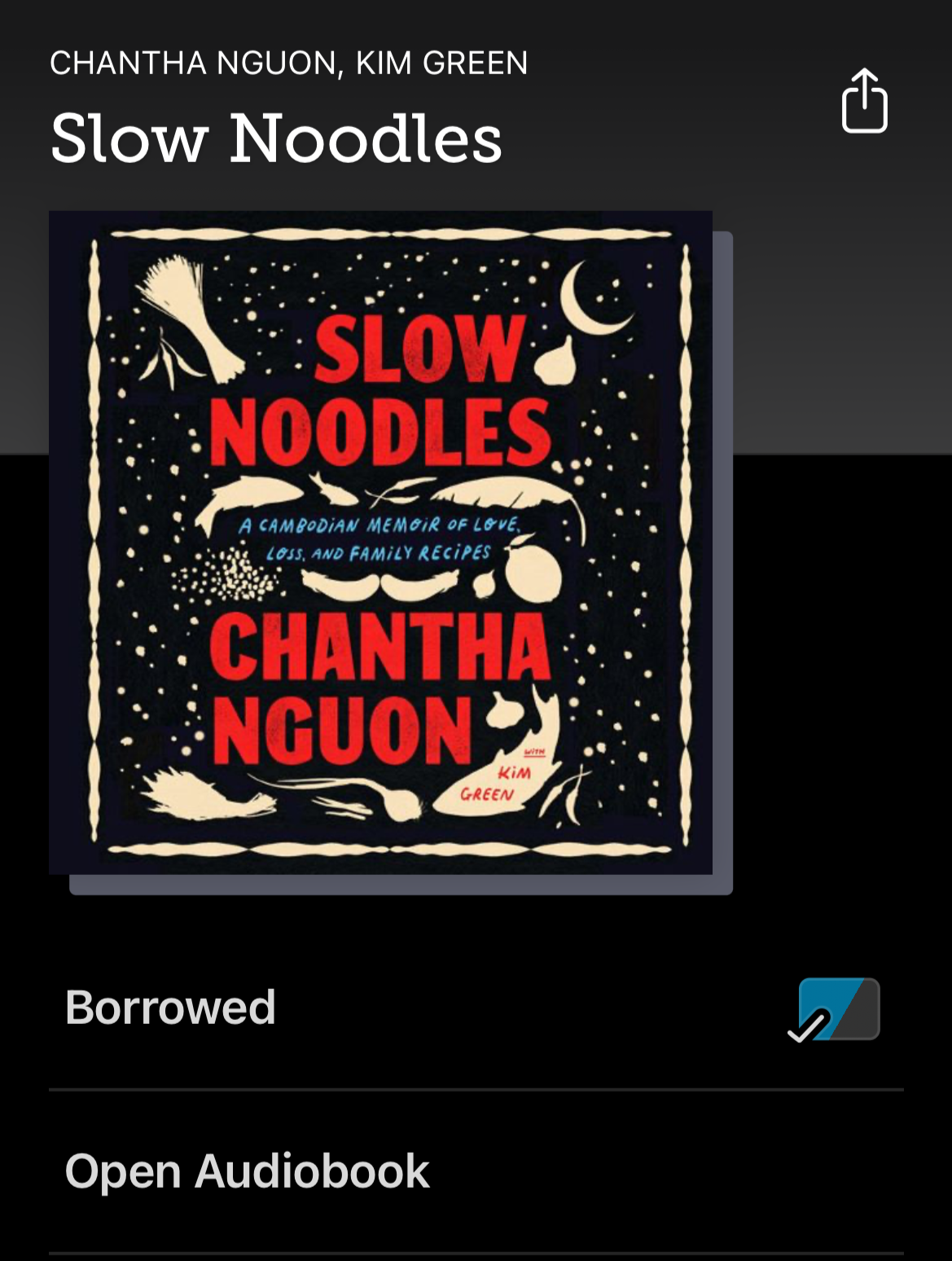
Slow Noodles: A Cambodian Memoir of Love, Loss, and Family Recipes by Chantha Nguon
Thankfully, Khmer people have clung tightly to tradition, community, and familiarity for the last 50 years. One of the few ways the culture could be preserved was through family and community meals, an experience that engages all five senses and evokes memories of home—a time and place before the genocide—much like the multisensory storytelling Chantha Nguon captures in her 2024 memoir, Slow Noodles.
These experiences, however, have varied across Khmer communities in the U.S., and even in other countries like Vietnam, depending on local ingredients and availability. The region of Cambodia a family comes from also shapes how culture is expressed through food. This also led to differing opinions on what is authentic Khmer cuisine. The distinct flavors—prahok, kreung, jruk, and tuk trey (fermented fish paste, spice paste, pickled vegetables and fish sauce)—are agreed upon, but as to which exact variations that get to exist on a plate, and therefore worth paying for, is often debated. While that cultural protection is a survival mechanism, it also means Khmer restaurants struggle to gain traction in the U.S., both within the community and beyond.
Wanting or pursuing authenticity and tradition in cuisine are not inherently problematic; the problem is that authenticity and tradition are easily conflated with quality and legitimacy. For the displaced generation that learned to assimilate into the Western world while preserving threads of their own, change is often a threat to their fabric of identity. This diasporic conundrum is the paradox that Khmer American restaurant owners face today.
In my experience, Khmer Americans do not feel drawn to Khmer restaurants because the food often does not measure up to what they eat at home. For many, the benchmark is their mom’s, auntie’s, or grandma’s cooking—or even their own—with flavors that are unapologetically bold, bitter, or fermented and carefully tuned to the memories of the motherland. To Khmer diners, if their notion of traditional flavors is not perfectly reflected on the plate, the dish is anything but authentic. And anything different is in jeopardy of being described simply as "not real Khmer food" and “no good.” And if it is not good, then it can never be deemed worth being paid for. And If Khmer diners are not showing up to Khmer restaurants, why would the wider dining world?
Simultaneously, to adapt the cuisine for broader audiences would be to threaten the fabric of one's cultural identity. Khmer foodpreneurs not only need to survive the unforgiving food scene, but they also must justify their vision. The result is a cuisine that is powerful, resilient, and rooted with history, yet still fighting for national visibility that isn't a flash in the pan.
With that said, popularity and financial success in the Western market does not necessarily indicate that Khmer cuisine has disappeared, nor has it been culturally cannibalized, despite influencing or even being considered co-opted by other cultures. Beyond dozen restaurants in Western Washington, it remains alive in homes, temples, gatherings, and the hands of elders who have carried it across the North Pacific Ocean, both before and after the atrocities of Pol Pot and his cadres.
BEYOND WAR, TRAUMA, AND PRESERVATION
I have scoured the internet for every online article I could possibly find about Khmer food in the U.S., and every single one of them mentions tradition or authenticity at least once. King 5's article on Theary Cambodian Foods has authentic in its title. Even Chef Theary’s own business sign uses the word authentic.
However, just before I began writing this blog post last October, San Francisco Standard released an article about Nite Yun's My Cambodia, a cookbook born from the success of her restaurant, Lunette. As far as I can tell, this may be the first ever U.S. article about Cambodian food that focuses on a family legacy rather than the legitimacy of the culture behind the menu. Last November, Chef Yun also hosted a Khmer potluck and book signing at Mam's Books, the first ever Khmer and Asian American independent bookstore in the Pacific Northwest.
The more I tap into the Khmer communities of Western Washington, the more that I feel a renaissance of Khmer American culture is around the corner. As the Khmer proverb goes: When the water rises, the fish eat the ants, but when the water recedes, the ants eat the fish. In other words, fortune ebbs and flows. Culture is cyclical, like the turning of the world, and prosperity tends to follow. But prosperity will only come once we learn how to preserve the past while still making room for the future.
My conversations with Theary have made me rethink how I show up for my community. For me, that means being more intentional about where I spend my time and food money. I still go out of my way to support Cambodian-owned doughnut shops; even though doughnuts aren’t Khmer, they’re woven into our diaspora’s entrepreneurial story—and into my family’s. My ability to engage with Khmer nonprofits is limited, but never on hiatus. And when it comes to dining out, I prioritize independent restaurants, especially Khmer and Southeast Asian ones, because that’s where my values feel most aligned. I would have denied myself a brief, unforgettable cultural journey had I not visited Theary Cambodian Foods.
I don't expect Chef Theary to fill the void that only my mother's cooking does; I eat her food because I want to eat her food. She curated a menu that offers something unique and elevated without "Americanizing" or white-washing Khmer cuisine. Her cooking resonates with me spiritually in a way other restaurants simply cannot. It transcends predisposed opinions of Khmer American food and culture while respecting the nuanced history and traditions behind it. Others just can't be bothered because some of her food is not traditional, but I argue that King 5 got it right: her cooking is authentically Khmer. More importantly, authentically Chef Theary's.
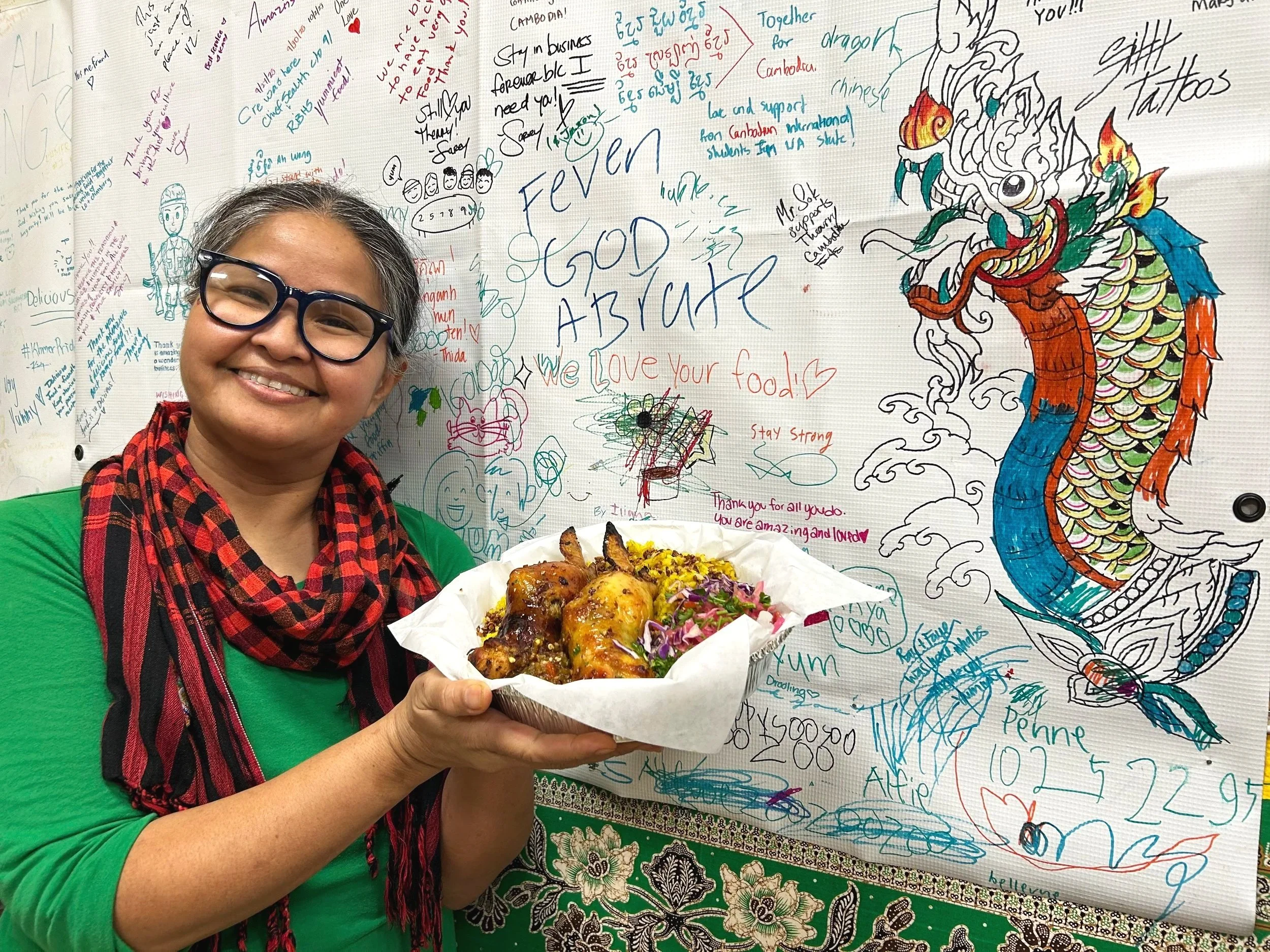
Chef Theary holding an order of stuffed lemongrass chicken, pickled vegetable salad, crispy garlic rice, housemade demon sauce, and housemade chili sauce.
If this blog resonated with you, please consider supporting my work by booking a service, reaching out to me, or sending me lui (funds) for num bang through the donation portal below.
Your support means the world. Awh gohn, Bong! 🙏